Introduction
As exam season approaches, our stress levels can slowly creep up on us. It is extremely important to try and manage our stress and implement strategies to mitigate the impact of this cortisol-spiking environment. Whether you are facing anxiety about sitting your first University exams, or the excitement of bidding goodbye to Evidence forever, this article will help to provide you with good strategies for stress management and tips for preparing for exams.
Stress Management Tips
Managing our stress is important for both our mental and physical well-being. Being stressed during the exam period is natural and can even help motivate us to work harder and smarter. However, in excessive amounts, stress can stunt our ability to study and result in ineffective workflow. We have provided tips and recommendations below on how to best manage stress to ensure that your study and preparation for exams can be as graceful as possible.
Rest
We often neglect rest during the exam period. It is so easy to say to yourself, “just one more case summary before bed” or “I’ll just figure out how Kirby dissented his way out of this one”. However, it is vital to take a break from studying from time to time - helping to consolidate the information we have just studied. Rest plays an important role in managing stress during exams by allowing the mind and body time to recover from long periods of study and pressure. Getting enough sleep improves concentration, memory, and emotional wellbeing, which can help you to perform better.
Taking short breaks between study sessions also reduces mental fatigue and prevents burnout. In addition, rest helps lower anxiety levels and allows students to return to their work feeling calmer and more focused. Maintaining healthy rest habits during exam periods can therefore improve both mental health and academic performance.
Catch up with friends
Being able to step away from the computer/books and catch up with people socially is a great way to recharge and give your mind a rest. Although it seems counterintuitive, it allows your brain to reset and potentially view the content from a different lens. It is important to differentiate catching up with a friend and a study group. If there are blurred lines, it can lead to half-baked study that is neither effective nor rejuvenating.
Get some outdoor time
It’s important to try and spend some time outside every day. Go for a coffee, spend some time in the park or even grab a picnic blanket and have a lie down in the backyard. A change of scenery can help you reframe your focus and helps to alleviate stress.
Breathing exercises
There are several breathing techniques that can help to alleviate us from the stress and pressure of exams. Regular practice of these methods can reduce stress and improve our capacity to study.
Box Breathing
This method, also known as square breathing, involves inhaling, exhaling and holding your breath for equal counts - typically 4 seconds. This technique is beneficial for reducing stress and anxiety, as well as emotional regulation, making it easier to think and handle high pressure situations. It also improves concentration, clearing mental clutter by providing a rhythmic anchor.
4-7-8 Breathing
To practice this technique, you must inhale through your nose for 4 counts, hold your breath for 7 counts and finally exhale completely through your mouth in a forceful breath for 8 seconds. This rhythmic pranayama yoga method calms the nervous system by promoting deep relaxation. It activates the parasympathetic nervous system, bringing the body out of a “fight or flight” mode and hence reduces anxiety and stress. It assists in relaxing the mind and tense muscles, leading to an improved quality of sleep.
Tips to get ahead on exams
To perform well in exams, it is useful to understand various tips that can get you ahead on exams. Knowing these tips and being able to implement them in your exam preparation will surely help you feel more prepared for the upcoming exam season and enhance your performance in exams.
The first and arguably the most crucial tip is to understand which topics are examinable for the exam. Examinable topics can vary widely depending on the unit that you are currently enrolled in, and it is crucial that you know what you will be examined on to prevent either revising areas you won’t examine on or not revising topics that you will be revised on. You will be able to find this information either via announcement made by the Chief Examiner (C.E) or the final examination information sheet available on Moodle. If you do not find this information via either channel, it is highly recommended that you get into contact with the C.E to confirm the details.
When you know what you will be examined on, it is important to understand how the exam will be structured. Such as how many sections there will be in total, how many marks will be allocated to each question. That way you can start allocating time that you will spend answering each question. This information will also be available via announcements by the C.E or the final examination information sheet, so keep an eye out for it!
Now it is crucial to find out whether practice exams will be made available for the unit. Oftentimes, practice exams will be made available on the revision page on your weekly learning page on Moodle. However, in some units, practice exams are either not available, or available in very small quantities, in these cases you can attempt to find practice questions from alternative sources. We recommend going through practice questions from weekly workshops or seminars and comparing answers to how the lecturer went through them. Alternatively, if you are a current LSS member, practice exam questions available on the LSS site are also very useful in preparing for the exam.
Moving on to the actual revision itself, it is crucial for you to undertake the revision of the content or construction of the notes before attempting the practice exams/questions. Practice exams/questions are oftentimes limited in quantity, meaning it is important to make the most out of what you have available. Thus, we recommend that you revise the content of the units thoroughly and make exam-ready notes before attempting these questions, this way you will get the most out of the exam questions.
Like most things in life, practice makes perfect in law exams. That’s why going through as many practice exams/questions will help you maximise your marks. We recommend you do as many timed exams as possible, preferably with a second device to recreate exam conditions as accurately as possible. This way, you will know how to use your reading and planning time and handle the pressure that comes with examination in exam conditions. We also recommend doing individual questions that you think you need to improve under time conditions as well; this way you can enhance your problem-answering skill in that area of law.
Study Techniques
When marching through reading after reading, the realisation sets in that success in your law exams don’t just result from hard work but smart work. So here are a few ways to really own the end-of-semester period.
Start with a plan, not a panic
This is fundamental to any of your units. Ensure you know what needs to get done. Are some topics incomplete? Do you need to revisit some cases? Be honest too! This allows you to conceptualise how much work you actually need to do, and ultimate alleviates some overwhelming stress that may be burdening you.
Checklists - online or in-person - are excellent here. Tools like Notion or even a fun paper to-do-list from Muji creates structure and a space for you to look at your weakest areas rather than defaulting to topics you’re already familiar with. Remember: success in academia comes from closing gaps, not boldening the foundations.
Chunking
Break down everything you need to get done into smaller ‘chunks’. This allows you to list out everything you need to get done before an exam and then set a due date for each task. Chunking not only acts as a great study tool to help retention, but also allows you to mitigate the overwhelm you may feel when facing a large amount of content.
Active recall over passive reading
When we’re told we’ll be allowed a second device for our exams, this isn’t a hand-out affirming things will be easier. We’re all exposed to and are of the same information, but it’s how we utilise this information when it feels burdensome.
Reading, then re-reading your notes is not effective. When there’s 12 weeks of content to get through, it’s better to give yourself ways to retain a surface level of concepts and case authorities without needing to look at them. So when the timer on your eExam is ticking down, your notes feel all over the place, and things are generally getting stressful, you know you can come back to what you already know.
You know these already but they work: flashcards, practice questions and teaching topics to peers and family all amount to a stronger skillset.
Use past exams early and often
Past exams (that are usually found on the Revision tab on Moodle) are a necessary resource for exam preparation! While we’re inclined to save them for the final weeks of revision as a ‘test’, the earlier we use them to assess the question structure and where gaps of knowledge may be found cement their value.
It’s not just the exam questions themselves - examiner reports or CE comments allow you to spot common mistakes and the requirements for a high-scoring answer. Furthermore, the earlier an adoption of timed conditions is made, the better!
Have focused blocks
Studies show that the correlation between time spent studying and grades are close to zero. This doesn’t mean you’re not expected to study to get a good grade, but long, unbroken sessions may eat into the time reserved for other aspects of your life, while producing diminishing returns on your productivity.
Having appropriate focused blocks of 45 minutes of genuine concentration, followed by a short break keeps your mind sharper. It also enhances your efficiency.
Shorter sessions of genuine focus are far superior to a longer session consisting of half-distracted skimming. There are plenty of ways to achieve this structured approach, however, the Pomodoro technique is a famous one.
Study groups: use them selectively
The activities you take with a group to have a collective study session can go either way in terms of success, so you need to be strategic.
Studies show that those who teach, experience more persistent learning gains. Take that in mind with your group. And at all costs, avoid sessions where you leave with a collective anxiety or social catch-ups dressed as revision. It creates a falsified psychological perception of the way you should be studying and approaching your work.
Formatting Exam Notes
The way your notes are formatted are critical too. Most exams go for 2.5 hours and if you’re not wise in your methodology, that time will fly. The best way to focus more on the questions at hand is to ensure your notes are succinct, well-presented and easy to follow.
No strategy is the same. No technique is better than the other. However, these are just some we feel will go a long way in strengthening your confidence or unlocking something new for you.
Chronologised order of content
Some legal units are a journey, where Week 1 covers the beginning of a story and Week 12 concludes it. For example, Contract A will examine the foundations of contract formation such as offer and acceptance, and eventuate into more complex scenarios, such as outcomes and remedies under the Australian Consumer Law.
It is critical that the order of content is understood, as not knowing concepts in Week 4 can affect the outcome for a concept in Week 10.
Other units are self-contained to that certain week’s topic, where overlap is only found in exam-based questions. For example, Constitutional Law examines judicial power all in one week, uncovering its history, past case authorities, concepts and requirements for certain tests to be met. Regardless, attention should be paid towards.
Steps for answering questions
Now that you have the content ordered, there will be sub-topics that need to be examined based on the scenarios given. Analysis is key, however, there are structures that are expected to be followed to attain the best marks possible.
If you see steps need to be followed, number them and make them clear. Design flow charts for a visual ‘pop’ when zooming through your notes. Utilise colours to create separation and delineation. And another important tip: your lecturers may have included some handy visuals in their own slides, so use them! And if your lecturer hasn’t, another one may have. You can find an example below:
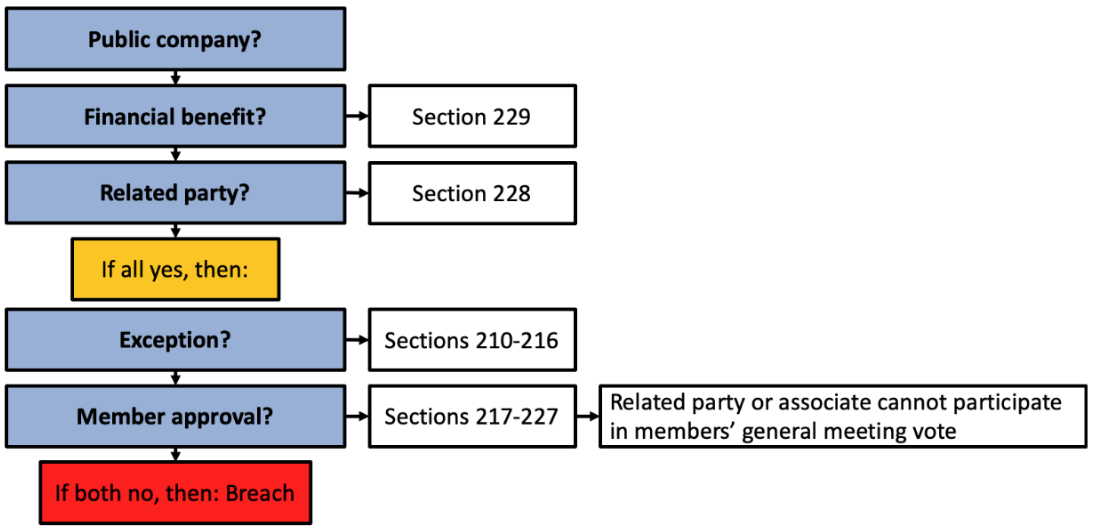
An example flow chart you might create!
Cases are a tool of support, not a weapon of attack.
Case authorities are important. They help reinforce arguments, engage with the doctrine of precedent and highlight your diverse knowledge and understanding of the law.
However, the key to using them is to not use them too much, which includes your notes. It is highly recommended to not have detailed summaries of the case, as it will just eat up into the amount of information you need to sift through. Instead, cite the case for the key principles they create and include a short sentence about their facts. This still allows you to analogise (which examiners love) and create connections between the scenario at hand, and cases you’ve been working hard on understanding this semester!
Here is an example on how you might use a case summary:
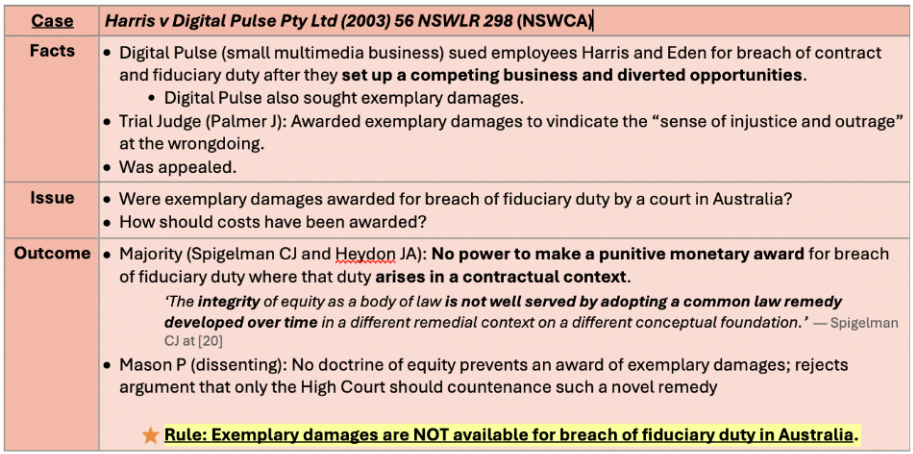
An example case summary you might use!
Make it short and concise, you do not need to go into the history of the law or anything that is not examinable.
Exams test for the application of the law rather than the substantial knowledge you have of the law. Thus, your exam notes do not need to contain every single detail of content you have learnt from your unit, rather it only needs to contain core knowledge that is relevant for your exam.
For example, in Criminal Law, we learn about individual rights and public interest, where in particular we study John Stuart Mill’s ‘On Liberty’. Although this topic is intellectually fascinating, it will often not be relevant for the purpose of answering an exam question. Rather, what needs to be included is the actus reus and mens rea element for various offenses that you learn about in the unit. It may be difficult to discern which topics are relevant for the exam, so a good rule of thumb is that history or background knowledge is often less relevant than the actual content of the law, which includes cases and statutes.
Take references from LSS notes and other notes available so you can use it effectively in the exam.
Often, it can be helpful to take reference from already-made notes to create the structure of your notes. If you are a current LSS member, the LSS sketch notes is a good place to start when it comes to structuring your own exam notes.
However, when doing this it is important to personalise your notes so that you know where each content is located, and which cases are relevant for the purpose of answering questions on certain topics. Additionally, using unaltered LSS notes runs the risk of leaving off content that has been newly introduced that is left out in the exam notes.
While these tips are very targeted towards law exams, the general strategies, and ways you go about making your understanding of the content as efficient as possible can be replicated anywhere. No matter if an exam is open or closed book, online or in-person, the discipline you instill is important.
Conclusion
Being prepared and implementing strategies to manage stress is a great way to set yourself up for success this exam season. By utilising these tips and tricks, you can enter your exams with confidence. Always remember to look after yourself first and ensure that you are looking after your mental and physical wellbeing. From all of us at A Reasonable Standard, we wish you the best with your exams and hope you are able to relax and enjoy the break when you are done!
Although this guide consolidates our advice on how to manage the exam season, sometimes you need some external help. Always remember that the Monash University Wellbeing Hub is available to students and is located in Campus Centre on Monash University Clayton Campus. Here you can make an appointment with a counsellor or doctor on campus and receive support if you need. We have provided a link below.
Wellbeing Hub: https://www.monash.edu/wellbeing-hub
If you need immediate assistance, call emergency services (000) or Lifeline (13 11 14) for support 24/7. Lifeline also provides online webchat options if you are more comfortable talking over text. We have provided a link below.
Lifeline Webchat: https://www.lifeline.org.au/chat
Written By Thomas, Noah, Abhi and Joe